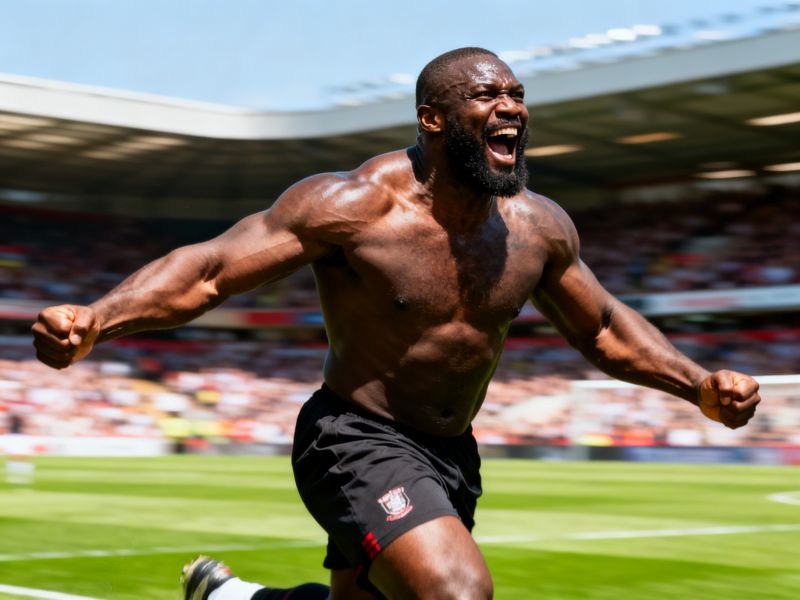
When Adebayo Akinfenwa stepped onto the pitch at Wembley for the 2015 League Two play-off final, few could have predicted the cult hero he would become. At 5-foot-11 and over 16 stone。he looked more like a rugby forward than a footballer. Yet there he was, leading the line for AFC Wimbledon, bullying defenders, and scoring goals. That day, Akinfenwa's physicality was unplayable;he won every header and held up play masterfully. It was a performance that encapsulated his entire career: an unapologetic embrace of his unique build, turned into a weapon.
Akinfenwa's journey through English football's lower leagues is a study in perseverance. He never played in the Premier League, yet his name resonates louder than many who did. From Barry Town to Swansea City。from Millwall to Northampton Town, he carved out a niche as a target man who could change games. His record speaks for itself: over 200 career goals, mostly in League One and League Two, and a reputation as one of the strongest players in the game. In 2016, he was voted the strongest player in the FIFA video game series, a testament to his legendary bench-press numbers (he reportedly benches 180kg). But Akinfenwa's influence extends beyond raw strength;his intelligence in the box, his ability to draw fouls, and his underrated link-up play made him a complete forward in his own right.What truly sets Akinfenwa apart is his personality. In an era of media-trained athletes, he is refreshingly authentic. He speaks his mind, celebrates with joy, and engages with fans on a personal level. His catchphrase "Beast Mode" became a brand, but it was never contrived—it reflected his playing style and his approach to life. When he scored for Wycombe Wanderers in the 2020 League One play-off final。his emotional interview afterwards, where he dedicated the win to his family, showed a vulnerable side rarely seen in professional football. That moment humanized him and endeared him to millions. Akinfenwa's use of social media is equally engaging;he interacts with supporters, shares training clips, and promotes his clothing line. He has built a post-football career as a motivational speaker, leveraging his story of overcoming doubt.Critics argue that Akinfenwa's style is one-dimensional, that his lack of pace limited him at higher levels. There is some truth to that;
he never played in the Championship consistently, let alone the top flight. But such criticism misses the point. Akinfenwa's success is about maximizing the cards you are dealt. He did not try to be a nimble winger;he became the best version of a physical striker. His longevity—playing professionally until age 39—is remarkable. In a sport increasingly obsessed with data and athletic prototypes, Akinfenwa is a reminder that there is more than one way to be effective. His legacy is not just goals and promotions, but the idea that unconventional athletes can thrive if they embrace their uniqueness. For every young player told they are too slow or too heavy, Akinfenwa offers a counter-narrative: work with what you have。and make it undeniable.